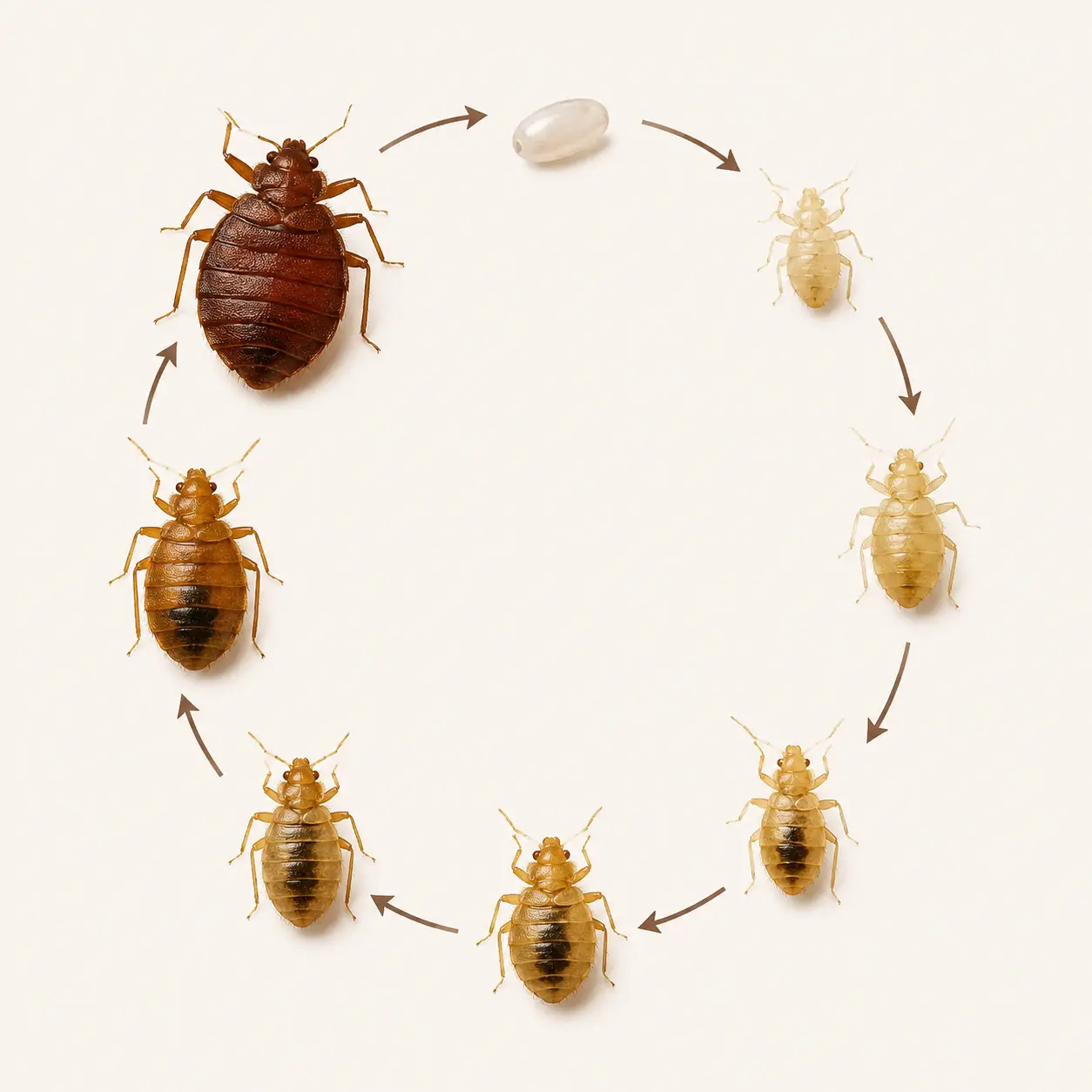
If you want to get rid of bed bugs for good, you first need to understand how they live, grow, and multiply. The bed bug life cycle explains why they seem to "come back" after treatment and why missing even a few can start the problem all over again.
Once you know how long each stage lasts, what they look like, and where they hide, you can time inspections and treatments much more effectively. Let’s walk through the full life story of a bed bug, from the first tiny egg to a blood-feeding adult.
Every bed bug goes through the same basic pattern: egg, several immature stages, then adult. This simple sequence is what pest professionals call a gradual pest life cycle, because the young look like small versions of the adults rather than completely different creatures.
Unlike many insects that live mostly outdoors, bed bugs complete their development indoors, close to their human hosts. That means the life cycle of bed bugs is heavily shaped by room temperature, access to blood meals, and how often bedding and furniture are disturbed.
The starting point is the egg, a tiny white capsule about the size of a pinhead. A single female can lay dozens of bed bug eggs over her life, placing them in cracks along headboards, behind baseboards, under loose wallpaper, or inside the seams of mattresses.
In warm rooms, eggs typically hatch in about 6–10 days, but cooler conditions can slow this down. Because eggs are glued firmly to surfaces and are resistant to many contact sprays, missing these in an early treatment often leads to small "surprise" outbreaks a week or two later.
Once the egg hatches, a tiny, almost transparent young bug emerges. This is called a bed bug nymph, and it must take a blood meal before it can grow to the next stage.
Nymphs pass through five growth stages, shedding their skins each time. At first they’re so pale that an unfed nymph can be hard to spot against light-colored bedding, but after feeding you’ll see a darker red-brown spot in the abdomen where the blood sits.
People often refer to the smallest nymphs as baby bed bugs, and that’s usually what you’ll see first in a new infestation. These early-stage bugs hide very close to where people sleep because they’re more vulnerable to drying out and need frequent access to a host.
Because they’re tiny and quick, they can easily slip into stitching on a mattress, behind a headboard, or into the screw holes of a bed frame. Catching these early requires patient, close-up inspection with a flashlight and, sometimes, a credit card or similar tool to probe seams and gaps.
Once a nymph completes all five molts, it becomes a breeding-capable adult. Bed bug reproduction depends on regular feeding, because females need blood to develop and lay new eggs.
In ideal indoor conditions, a healthy adult can live for several months, and during that period it may produce batches of eggs over and over again. That ongoing bed bug breeding is what turns a few hitchhikers in luggage or furniture into a heavy infestation in just a matter of weeks or months.
Under typical room temperatures, it can take about five to eight weeks for a newly hatched nymph to reach adulthood, assuming it can find a human host to feed on regularly. This timeline means the total bed bug lifespan, from egg to the end of the adult stage, often stretches from several months up to nearly a year.
Lower temperatures and irregular feeding can slow the life cycle dramatically, which is one reason infestations sometimes seem to "go quiet" and then flare up again when conditions improve.
Unlike some insects that can feed on crumbs or garbage, bed bugs feed only on blood, and their mouthparts are specially adapted for this purpose. This narrow diet is one of the most important facts of bed bug biology, because it ties them tightly to sleeping and resting areas.
They also prefer tight, dark spaces where their flat bodies can squeeze between surfaces. These hiding behaviors affect how professionals search for them and where monitoring devices are placed.
Every treatment plan works better when it’s built around the timing of each bed bug stage. For example, if a product doesn’t affect eggs, a follow-up visit must be scheduled after they hatch but before new adults start to lay again.
Knowing which areas are most attractive to each stage also helps. Small nymphs stay close to the bed, while larger adults spread outward into nightstands, picture frames, and even electrical outlets if the population grows.
If you understand the bed bug life cycle, you can turn that knowledge into a more effective response at home. The goal is to interrupt their development so fewer young survive long enough to reproduce.
Targeted cleaning, consistent monitoring, and properly timed professional treatments work together to break the chain from egg to adult. Skipping any of those steps usually gives the surviving bugs another chance to spread.
Early in an infestation, focus on the bed and nearby furniture where the youngest bugs tend to stay. As bed bug stages progress and numbers rise, widen your inspections to include couches, chairs, curtains, and nearby clutter.
Simple tools like mattress encasements, interceptor cups under bed legs, and vacuuming along seams help reduce populations and make it easier to see new activity quickly.
Plan follow-up checks about two weeks after any treatment to catch newly hatched nymphs.
Wash and heat-dry bedding and soft items regularly to remove hidden insects.
Reduce clutter so that all life stages have fewer places to hide.
Use monitors in sleeping areas to spot early activity before it becomes widespread.
Professional technicians also factor the life cycle of bed bugs into their treatment schedules, choosing products and methods that address both active bugs and those that may emerge later.
Clear communication about what you’re seeing between visits helps them adjust the plan and focus on areas where new signs appear.
Understanding the bed bug life cycle gives you a clear picture of why these pests are so persistent and why one quick spray almost never solves the problem. When you line up your inspection, cleaning, and treatment efforts with the timing of their development, you stack the odds firmly in your favor.
If you’re seeing signs at any stage, from faint stains to visible adults, it’s smart to bring in experienced help so the infestation is cut off before it spreads further; a trained team like Kiran Enterprises can design a plan around your space, your schedule, and the way these insects actually live.
Get a same-day inspection from our certified technicians.
Chat on WhatsAppOr call +91 98452 73699