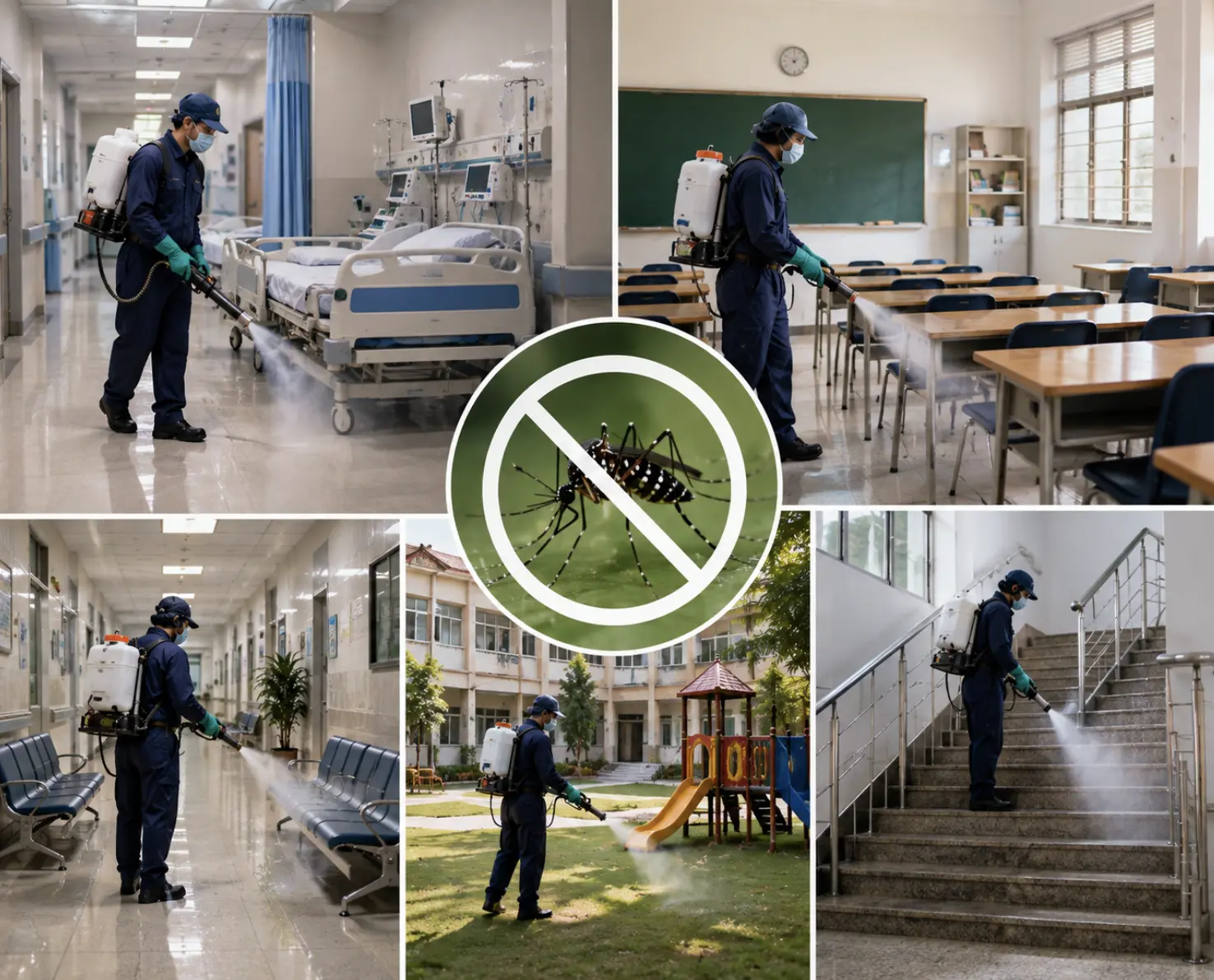
Mosquito control for hospitals isn’t just about comfort. In Bangalore and Mysore, it sits right next to infection control and patient safety, especially with dengue, malaria, and chikungunya in the picture for most of the year.
If you manage a hospital, clinic, or school campus, you already know complaints spike after the first pre-monsoon showers. Fogging alone doesn’t fix it, and neither do one-off sprays. You need a plan that’s safe for patients and children, effective against local mosquito species, and practical for your maintenance team to run week after week.
In hospitals, open drains, sump areas, and cooling towers create perfect breeding pockets, so a generic mosquito treatment every few months almost always fails. The risk isn’t just nuisance bites; it’s disease transmission in wards where patients already have low immunity.
In schools, morning assemblies, playgrounds, and bus bays expose children during peak mosquito activity times, which makes targeted mosquito control for schools a health decision, not just a comfort feature parents ask about.
Most facilities teams already use some kind of commercial mosquito control, but they still see adult mosquitoes inside ICUs, OPDs, and waiting halls. That usually means the treatment is focused only on killing flying adults and ignoring breeding sources within or just outside the boundary.
The second problem is safety. Any mosquito pest control method inside hospital premises has to be odourless or very low odour, non-irritant, and compatible with oxygen lines, sensitive equipment, and poor ventilation in older blocks.
The most reliable approach starts with an inspection and mapping exercise before any mosquito management work begins. The team should mark overhead tanks, sumps, stormwater drains, flower pots, discarded containers, and construction zones, and flag those for larval control first.
Next comes targeted residual spraying along dark corners, lift shafts, duct areas, staircases, and behind furniture using hospital-grade insecticides, keeping exposure to patients and staff as low as possible while still providing a long protective band.
One of the biggest mistakes is booking mosquito treatment only when complaints spike, which creates a cycle of panic fogging that looks impressive but offers just a few hours of relief. A better approach is a fixed schedule tied to local weather patterns and vector surveillance reports.
A second mistake is letting general maintenance teams handle hospital pest control with consumer aerosols, which often leads to overuse in occupied areas and under-treatment of ducts, basements, and service passages where mosquitoes actually rest.
A good provider of professional mosquito control will share a written plan that covers inspection, larval treatment, adult control, monitoring, and documentation rather than just quoting for “fogging” and “spray”. Insist on clear segregation of high-risk zones like ICUs and operation theatres with custom protocols.
Ask direct questions about chemicals, WHO or NVBDCP guidelines followed, and how they protect sensitive areas, then check that their technicians are trained to work specifically inside medical environments, not just general housing complexes.
For school campuses, the focus of mosquito control for schools should be outdoor-heavy but still structured, covering playgrounds, assembly areas, canteens, and hostels. Since treatment often happens while teachers and non-teaching staff are present, timing and communication matter almost as much as the chemicals used.
Another priority is drainage near sports fields and low-lying patches where water collects after rain, because that’s where mosquito treatment should be concentrated during the breeding season instead of random fogging on open grounds.
To protect children and staff, school pest control is usually best scheduled on weekends, holidays, or late evenings so that residues can settle and odours clear before regular timings. This also gives time to air classrooms and labs without affecting timetables.
Simple housekeeping steps, such as fixing leaking taps, emptying small water trays under plant pots, and covering small storage tanks, often remove half the breeding spots before any chemical work even starts.
Any serious mosquito management programme in Bangalore or Mysore typically mixes larviciding, residual spray, and limited fogging instead of relying on one method. Used together in the right order, these steps deliver a noticeable drop in bites within two to four weeks.
For indoor areas, targeted mosquito pest control with residual insecticides on resting surfaces—such as under tables, behind curtains, and along skirting—can keep adult populations down for several weeks without constant re-spraying.
Outdoor mosquito prevention should start with source reduction: clearing clogged gutters, treating stagnant drains, and managing construction debris, especially after summer thunderstorms. Larval control with approved products in unavoidable water bodies is the next layer.
Fogging can still play a role around perimeters, parking bays, and dense landscaping, but it should support, not replace, routine inspection and treatment in and around key risk points.
For large campuses, most pest control services begin with a detailed site survey and share a layout with marked breeding sites, resting areas, and movement paths. They then recommend a monthly or biweekly schedule based on your case mix, footfall, and weather.
On each visit, the team should follow a checklist that covers larval treatment, indoor spray, outdoor fogging where really needed, and a quick audit of housekeeping gaps so the facility team knows what to fix before the next cycle.
If you’re shortlisting commercial mosquito control providers, start by asking what percentage of their work is in healthcare and education, rather than housing complexes. Experience with NABH or JCI-audited facilities is a strong sign they understand compliance and documentation.
For school pest control contracts, ask for a treatment calendar for the academic year, with heavier mosquito treatment work planned before and during monsoon and lighter maintenance visits during cooler, drier months.
“What chemicals do you use” — Are they approved for hospital pest control in India?
“Can you provide MSDS sheets” — Along with treatment records for audits and inspections.
“How do you minimise disruption” — In ICUs, wards, classrooms, and labs.
“What is your response time” — If mosquito activity spikes between scheduled visits.
“Do you offer staff training” — On basic mosquito prevention measures.
Consistent, safe mosquito control for hospitals and schools in Bangalore and Mysore needs more than last-minute fogging; it needs a plan that blends inspection, larval treatment, and targeted spraying with simple housekeeping fixes your team can maintain. When that structure is in place, complaint calls drop, and so does the risk linked to vector-borne infections.
If you’re ready to put a structured mosquito treatment programme in place for your campus, speak with Kiran Enterprises about a survey visit and customise a schedule that fits your layout, risk level, and budget.
Get a same-day inspection from our certified technicians.
Chat on WhatsAppOr call +91 98452 73699