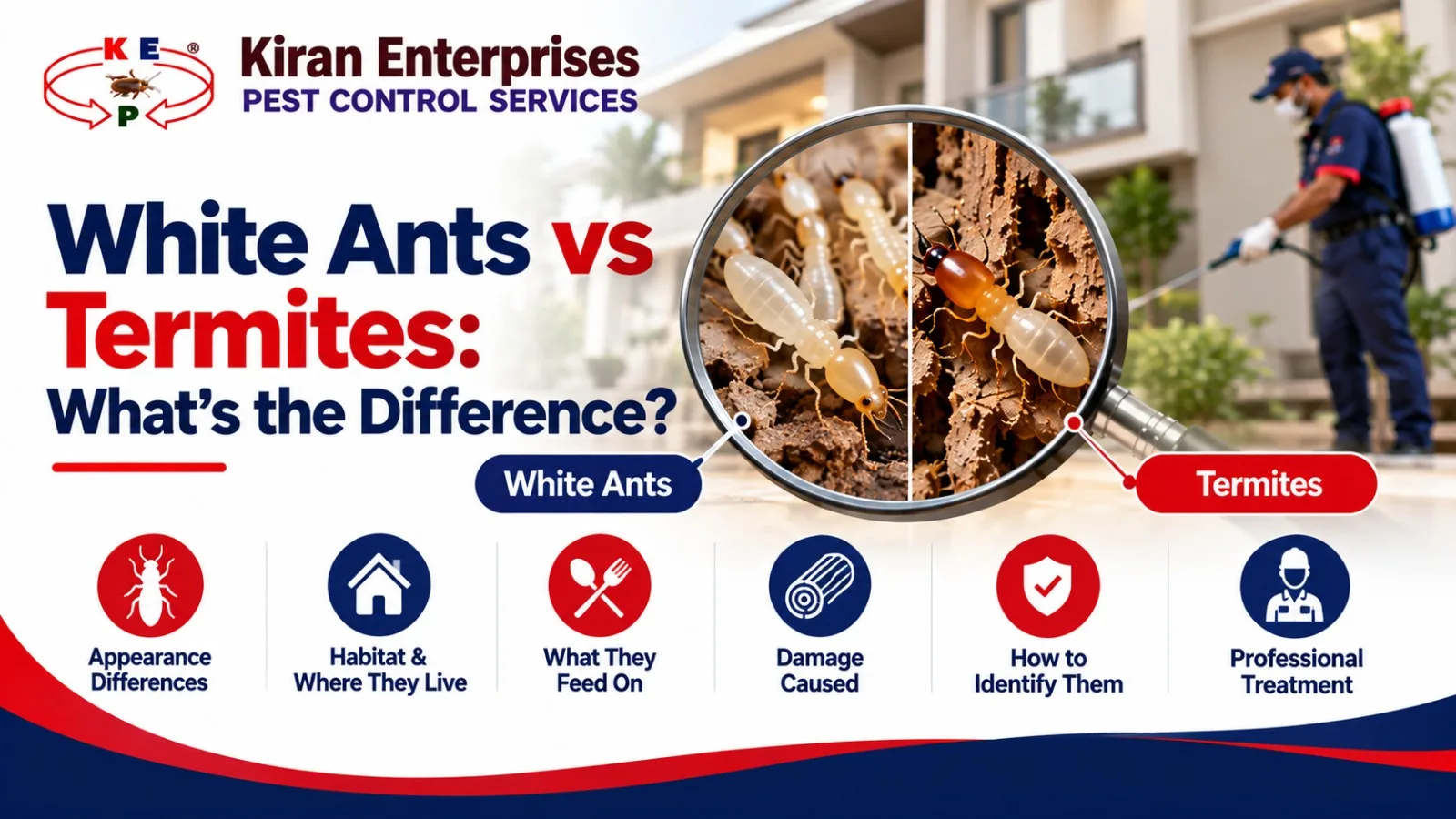
Seeing tiny insects in your wood and not sure if it’s white ants vs termites? That confusion is common in Bangalore and Mysore, and it can get expensive if you guess wrong.
Ants can be a nuisance, but termites are wood destroying insects that quietly eat through doors, furniture, and even structural beams. Knowing which one you’re dealing with helps you act fast, call the right help, and choose the right treatment.
Termites are often called white ants because they live in colonies, have workers and soldiers, and move in lines, just like ants. To an untrained eye, they look similar, especially when they swarm.
The problem is that this casual name leads many homeowners to assume a minor ant problem, when they’re actually looking at a serious termite infestation that can damage a wooden cupboard in a few months.
Start with the body shape. Regular ants have a narrow "waist" and bent elbows on their antennae. Termites have a straight, thick body with no pinched waist and straight, bead-like antennae, which is a core part of termite identification.
Next, look at colour and hardness. Ants are usually darker and have a harder, shiny outer shell. Termites are pale cream to light brown and look softer and almost translucent, especially the workers you see when wood is disturbed.
Most people first notice termites during swarming season, when winged reproductives come out near windows, tube lights, or balcony doors. Swarming often happens in the evening after rain in cities like Mysore.
Flying ants and termite swarmers look alike from a distance, but there are clear differences that can help you catch a termite infestation early.
Check the wings first. Flying ants have two pairs of wings of different sizes, with the back pair shorter. Termite swarmers have four wings of equal size that are longer than their body, a quick trick in pest identification when you see discarded wings on floorsills.
Then look at the waist. Winged ants still keep that narrow waist. Termite swarmers have a straight, uniform body from head to tail, which is why pest control technicians can identify them in seconds.
Ants usually build nests in soil, cracks, or small gaps in walls. They might enter kitchens or balconies looking for food but rarely eat solid wood, so they don’t behave like typical wood destroying insects.
Subterranean termites, common in Bangalore, build nests underground and travel through hidden mud tubes to reach wood. That’s why you often don’t see them until plaster starts to bubble or doors suddenly become hard to close, making termite treatment more urgent.
Termite damage is subtle at first. You might see small mud lines on walls, hollow-sounding wood when tapped, or thin, papery surfaces that crumble when pressed.
In Mysore’s older houses with more wooden frames, this can show up as sagging door frames or skirting boards that crumble on touch, long before you realise the level of termite control that will be needed.
If you’re unsure what you’re seeing, focus on behaviour and the marks they leave behind, not just the insect itself. Termites avoid light and usually move inside wood or mud tubes, while ants move openly.
One strong sign of termite infestation is finding piles of discarded wings on window sills, around tube lights, or near balcony doors after an evening swarm.
Tap door frames, window frames, and wooden cupboards. A hollow sound is a red flag and calls for serious termite identification.
Look for mud tubes on walls, near skirting, or along electrical conduits heading toward wooden structures.
Check built-in wardrobes, lofts, and pooja shelves, especially in damp corners or walls that touch bathrooms.
Inspect cardboard boxes stored against walls in basements or low-ventilated rooms for early signs of pest management issues.
If you break a mud tube and see soft, pale insects rushing back inside, you’re looking at termites, not ants.
Most supermarket ant sprays only kill insects on the surface. They might reduce visible ants but won’t touch a hidden colony deep in soil or wall voids, so they’re almost useless as serious termite treatment.
Professional termite control in Bangalore and Mysore usually follows a structured process, especially for concrete and tiled homes that hide internal wiring and pipes.
“Inspection and mapping” — Technicians inspect all floors, woodwork, and likely entry points, then map active and high-risk zones that need termite control.
“Drilling and injection” — Small holes are drilled along skirting or junctions of wall and floor, and termiticide is injected to create a treated barrier.
“Wood treatment” — Existing wooden furniture, doors, and frames are treated with a liquid or gel chemical to protect against further termite prevention issues.
“Soil and exterior treatment” — For ground-floor flats or independent houses, soil around the building is treated to cut off termite access.
This isn’t a one-spray job. A good service will give you a multi-year warranty and schedule follow-up checks to keep pest management under control.
You can’t remove termites from the environment, but you can make your home less attractive to them. Focus on moisture, wood-to-soil contact, and early inspection habits to improve termite prevention.
Small changes in how you store and maintain wood, especially in ground-floor flats and independent houses, can save major repair costs over a few years.
Fix plumbing leaks quickly, especially under sinks and inside bathroom walls, as dampness attracts termites that lead to more white ant treatment needs later.
Keep wooden furniture slightly away from walls so you can inspect the back and sides at least once every few months as part of regular pest identification.
Avoid storing cardboard boxes directly on floors in basements or closed rooms; use plastic crates where possible to avoid wood destroying insects.
Seal cracks around windows, doors, and utility lines where mud tubes can form and compromise your overall termite control strategy.
Schedule an annual professional inspection, even if you don’t see obvious signs, especially in older properties with more wooden fixtures that may require targeted termite prevention.
These habits don’t replace professional treatment, but they buy you time and help you catch problems before they spread.
Once you understand the real differences in body shape, wings, and behaviour, the confusion between white ants vs termites disappears, and you can respond calmly instead of guessing. Quick identification means your wood, and often your budget, stays safer.
If you’ve spotted suspicious insects or damage in your home in Bangalore or Mysore, call a trusted local expert like Kiran Enterprises, share clear photos, and schedule an inspection so you can confirm exactly what you’re facing and choose the right solution before the problem spreads.
Contact Kiran Pest Control to discuss the issue and arrange an inspection.
Contact our teamGet a same-day inspection from our certified technicians.
Contact Our Team Chat on WhatsAppOr call +91 98452 73699