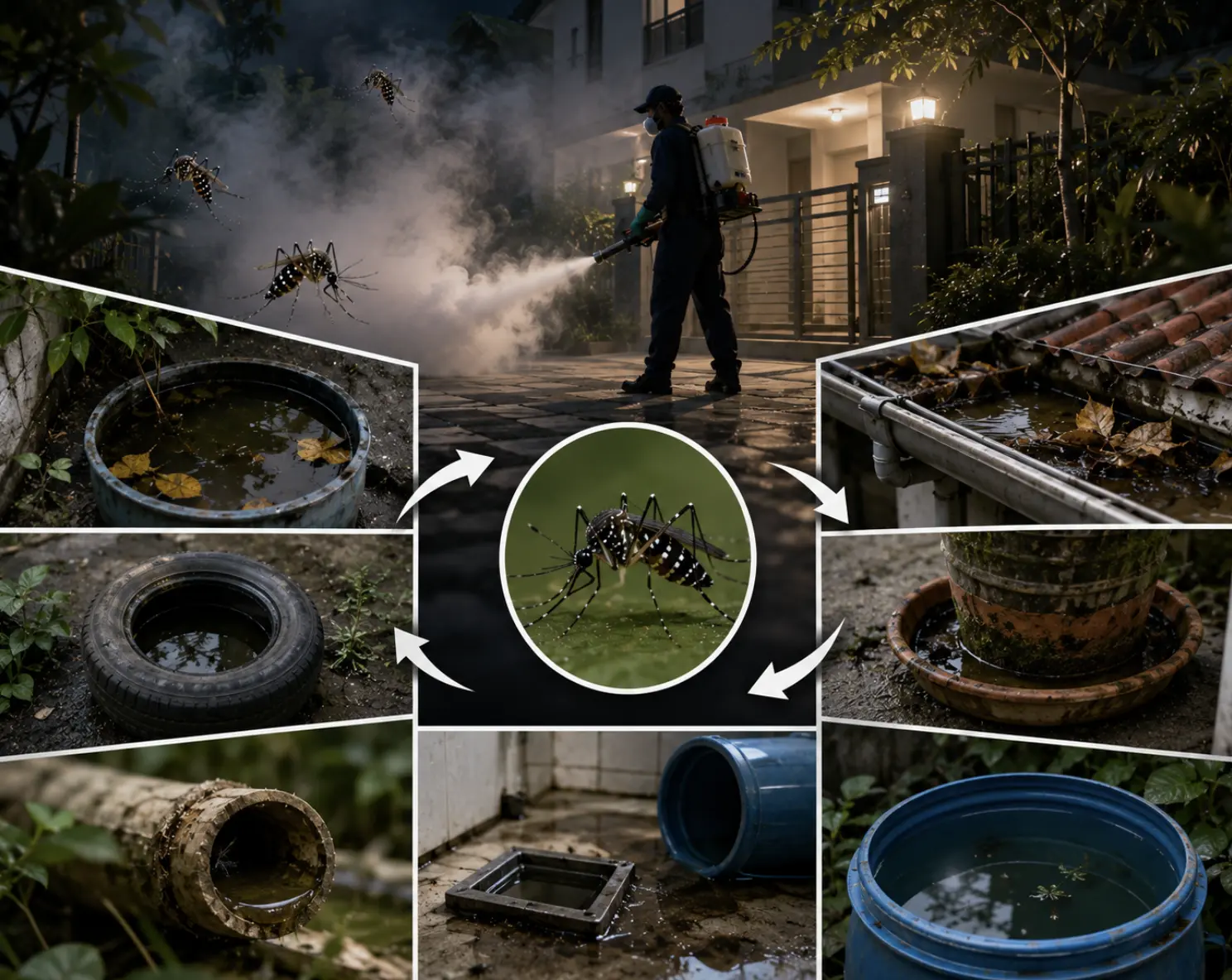
If you still see mosquitoes after fogging, you’re not alone. Many homes and layouts across Bangalore and Mysore call pest control, see the white smoke, feel hopeful for a day or two… and then the buzzing and biting quietly return.
The problem usually isn’t that mosquito fogging “doesn’t work”. It’s that the treatment is used the wrong way, at the wrong time, or without supporting mosquito prevention steps that keep new mosquitoes from replacing the ones that died.
Fogging kills mosquitoes that are active and exposed during the treatment window. It does almost nothing to eggs, pupae, or adults resting deep inside dense vegetation or clutter. Those survivors are the ones that repopulate your space.
Most mosquito species that bother people in Bangalore have a short life cycle. Fresh adults can emerge from standing water in as little as 7–10 days, so a single mosquito fogging session is more like a reset button than a full solution.
Many homeowners call for mosquito control only when the itching becomes unbearable or a dengue scare hits the neighbourhood. By that time, there are usually multiple breeding sites on and around the property.
A better approach is to plan regular mosquito pest control schedules during peak seasons. For Bangalore and Mysore, that usually means pre-monsoon, through the rains, and a few weeks after, when standing water tends to linger.
Fogging targets flying adults, but it doesn’t stop new mosquitoes from hatching. Even a bottle cap filled with water can support mosquito breeding if it sits undisturbed for a week or so in a shaded corner.
Walk around your property and note every place water can collect for more than three days. Overhead tank lids that don’t close snugly, plant trays, tarpaulins over construction material, and unused open wells are repeat offenders in many Bangalore houses.
In many “quick fix” mosquito treatment jobs, technicians only fog outdoors and leave. That gives a few hours of comfort but misses mosquitoes resting on cool, shaded indoor walls, under furniture, or in stairwells.
Residual spraying places a measured insecticide film on walls and other resting surfaces. When adult mosquitoes land there, they pick up a lethal dose, cutting down the population over several days instead of just softening it for one evening.
Timing matters more than most people realise. If fogging is done when mosquitoes are not actively flying, the smoke looks impressive but the impact is minimal. This is one reason people complain that mosquito management “did nothing”.
Most Aedes mosquitoes, which spread dengue and chikungunya, are active during early morning and late afternoon. Culex and Anopheles, which cause night-time nuisance and disease, peak from dusk onwards. Your technician should match fogging time to the dominant species in your area.
In tightly packed layouts, fogging just inside your gate is rarely enough. Mosquitoes can fly in from storm drains, vacant plots, and neighbouring houses that skip mosquito fogging. You feel relief for a night, then the population flows back in.
Where possible, coordinate mosquito management with your association or street. Treating contiguous areas together gives far better results than one bungalow doing everything perfectly while the next three ignore basic mosquito prevention.
Most people expect a single treatment to keep mosquitoes away for weeks. That’s unrealistic. Under typical monsoon conditions in Bangalore and Mysore, fogging alone gives noticeable relief for roughly 3–5 days.
Adding residual spraying on key surfaces can stretch that comfort window. With proper follow-up, many households see reduced bites for 10–14 days, especially when breeding sources are also eliminated.
Seeing a few mosquitoes after treatment doesn’t always mean the work was badly done. Some adults rest in cool cracks or thick foliage during fogging and avoid lethal contact. Others may drift in from nearby untreated zones.
What matters is whether the overall biting pressure drops sharply and stays lower for several days. That’s a better measure of professional mosquito control than expecting zero mosquitoes, which isn’t realistic in urban India.
Fogging is best thought of as a quick knockdown method. It targets swarms and gives fast relief for outdoor gatherings, events, or when a colony has clearly flared up around your home.
Residual spraying, in contrast, is the slow, steady workhorse of mosquito treatment. By coating walls, staircases, basement pillars, and shaded verandas, it keeps killing resting mosquitoes long after the fog has cleared.
No pest control services can keep mosquitoes away if the property invites them back. The daily and weekly habits between visits make the real difference, especially through the rains.
Use this simple routine that works well for independent houses, villas, and smaller apartments in Bangalore and Mysore:
“Every 3 days” — Empty and scrub buckets, plant trays, pet bowls, and AC drain trays.
“Weekly” — Check terrace, balcony corners, and sump lids. Repair or tape over small gaps mosquitoes can enter.
“After heavy rain” — Clear water pooled on tarpaulins, plastic sheets, discarded tyres, and construction debris.
“Every visit from housekeeping” — Ask them to pour out water from mopping buckets outside, not let it sit overnight.
For high-risk family members like young children, seniors, or anyone with low immunity, combine property checks with personal measures such as bed nets and long sleeves during peak mosquito hours.
A good provider doesn’t just show up with a fogging machine and disappear in ten minutes. They inspect, ask questions about your building layout and drainage, and explain the mix of fogging and residual spraying they’ll use.
Ask what chemicals they use, how long you should stay away after treatment, and how many rounds they recommend for your specific layout. Clear, specific answers are a good sign that they treat mosquito pest control as more than a one-off job.
Some situations call for faster, more aggressive mosquito management instead of waiting for the next planned service date. Frequent dengue or malaria cases in your immediate area are the most obvious triggers.
Other red flags include thick mosquito swarms near storm drains, open construction sumps left unattended, and strong odours from stagnant water pits that suggest heavy mosquito breeding nearby.
If bites are back to pre-treatment levels within 24–48 hours, something is off. Either the timing, the technique, or the surrounding environment is fighting your efforts.
Keep a simple log of when you receive mosquito fogging, how long relief lasts, and where you notice the worst swarms. Sharing that with a new provider helps them fine-tune a smarter mosquito management plan from day one.
Persistent mosquitoes after fogging usually point to gaps in timing, breeding control, or follow-up treatments rather than a single bad service. Once you combine targeted fogging, residual spraying, and basic weekly prevention habits, you’ll start to feel the difference around your home.
If you live in Bangalore or Mysore and want a structured plan instead of one-off fire-fighting, speak with a local expert like Kiran Enterprises about a seasonal schedule that keeps mosquitoes after fogging under control before they become a daily irritation.
Get a same-day inspection from our certified technicians.
Chat on WhatsAppOr call +91 98452 73699